
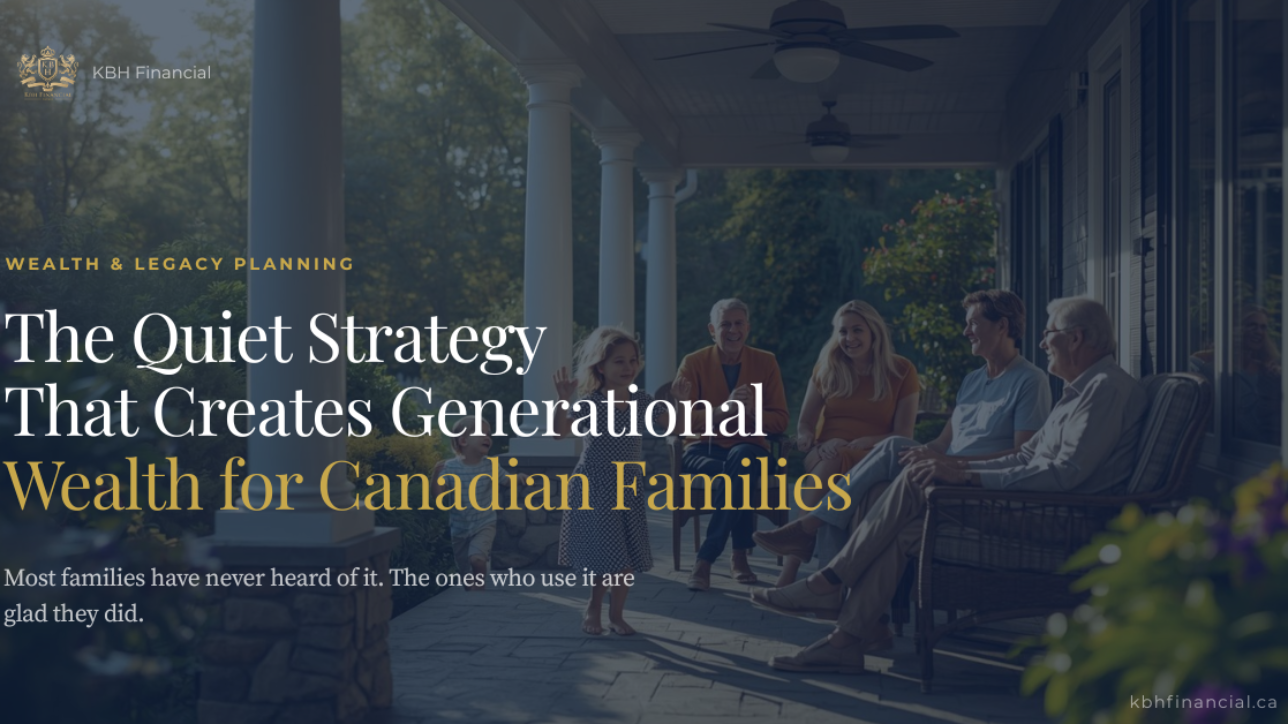
Most families have never heard of it. The ones who use it are glad they did.
There is a moment that many grandparents know well.
It happens quietly, often when you least expect it.
Maybe you’re watching your grandchild open a birthday gift. Maybe you’re sitting around the dinner table with three generations under one roof. Maybe it’s a simple Sunday afternoon and you look around and think – I want this to last.
Not just the afternoon, but the security. The opportunities. The foundation you spent a lifetime building.
Most grandparents I speak with have thought seriously about leaving something meaningful behind. They’ve made wills. Some contribute to RESPs for their grandchildren. Many have had conversations with their adult children about what should happen to their estate.
But very few have heard of a strategy that quietly does something none of those things can do on their own.
It doesn’t make headlines. It doesn’t come up at dinner parties. But for the Canadian families who use it thoughtfully, it can create a generational waterfall of wealth, growing tax-free and compounding silently across three or even four generations.
It’s called Cascading Life Insurance.
If you have adult children and grandchildren you love, and care deeply about what you leave behind, it’s worth understanding.
THE PROBLEM WITH TRADITIONAL GIFTING
Most grandparents are very generous.
They may contribute to education funds, They help with down payments, They slip money into birthday cards and quietly cover expenses they were never asked to cover. They give because they love, and because they’ve worked hard enough to be able to.
But here’s something worth considering.
Most of the traditional ways we transfer wealth to the next generation come with limitations that are easy to overlook until it’s too late.
Cash gifts, however generous, tend to get spent. That’s not a criticism, it’s simply human nature. Money without structure rarely compounds into something meaningful.
RESPs are wonderful tools for education savings. But they are restricted to educational purposes, and the government grants that make them attractive are taxable on withdrawal. They also stop accepting contributions once the beneficiary reaches a certain age.
Leaving wealth through a will sounds straightforward, but wills go through probate, which takes time, costs money and makes your estate a matter of public record. In some provinces the probate fees alone can represent a meaningful percentage of the estate’s value, and the wealth that finally reaches your grandchildren arrives all at once, without structure, often at an age when they may not be fully equipped to manage it wisely.
None of these are bad strategies. Most families should use some combination of them.
But there is a gap. A quiet space between what traditional tools can do and what most Canadian families actually want for their grandchildren.
They don’t just want to give their grandchildren money.
They want to give them a foundation. A head start. A tax-free, protected, growing asset that compounds quietly in the background while life happens around it.
That’s exactly what Cascading Life Insurance is designed to do.
WHAT IS CASCADING LIFE INSURANCE?
Cascading Life Insurance is a whole life insurance strategy that allows wealth to flow, or “cascade” from one generation to the next, growing tax-free along the way.
The concept is elegant in its simplicity. But the results, when implemented thoughtfully and early enough, can be genuinely remarkable. Wealthy families in Canada have used this strategy for decades.
Here is how it works.
THE GRANDPARENT: THE ARCHITECT OF THE PLAN
The grandparent takes out a whole life insurance policy, but not on their own life. Instead, the policy is taken out on the life of their adult child. This is an important distinction that surprises many people when they first hear it.
As the policy owner, the grandparent pays the premiums. They maintain full control of the policy and can access the cash value at any time if they need to. They can also transfer ownership of the policy to their adult child at any time, or leave that transfer to happen naturally as part of their estate. Importantly, that transfer of ownership happens free of tax.
THE ADULT: THE LIFE INSURED
The adult child is the life insured on the policy. Because they are younger and typically in good health, the premiums are significantly more affordable than they would be on the grandparent’s own life. This is one of the key reasons the strategy works so well, because time and age are powerful allies here.
The adult child must consent to being the life insured. Once ownership eventually transfers to them, they can continue contributing to the policy, access the cash value to fund major life events, and name their own children, the grandchildren, as the beneficiaries.
THE GRANDCHILDREN: THE BENEFICIARIES
When the life insured eventually passes, the grandchildren receive the death benefit completely tax-free. That benefit can be very substantial, the result of decades of tax-free compounding inside the policy.
But the story doesn’t have to end there.
The grandchildren can take those proceeds and start the cycle again by taking out policies on their own adult children, for the benefit of their grandchildren. This is the “cascade”: a generational waterfall of wealth that flows forward through time, growing with each generation.
THE THREE THINGS THAT MAKE THIS STRATEGY POWERFUL
First, the cash value inside a whole life policy grows tax-free and is guaranteed never to decrease. It is completely insulated from stock market volatility and interest rate fluctuations. In uncertain economic times, that stability is genuinely valuable.
Second, the policy owner maintains full control and access. This is not money locked away until death. The grandparent can access the cash value at any time, for any reason, without penalty. It is a living asset as much as it is a legacy tool.
Third, the death benefit passes to the grandchildren completely free of tax. No probate. No delays. No public record. Just a clean, structured, tax-free transfer of wealth to the people you love most.
This strategy has been available to Canadian families since 1848. It is not new. It is not complicated. It is simply underused, because most families never have the conversation that would introduce them to it.
A SIMPLE ILLUSTRATION
Sometimes the best way to understand a strategy is to see it in action.
Let me walk you through a straightforward example. The numbers below are illustrative — they are not a guarantee of any specific policy or insurer’s performance. Every family’s situation is different, and actual results will depend on the specific policy, the insurer, the age and health of the life insured, and a number of other factors. A qualified advisor can provide a personalised illustration for your specific circumstances.
With that said, here is how the strategy might look for a typical Canadian family:
MEET THE FAMILY
Margaret is 64 years old. She has worked hard, saved carefully and built a meaningful estate over her lifetime. She has one adult son, David, who is 38 years old and in good health. David has two young children, Margaret’s grandchildren, aged 4 and 6.
Margaret wants to leave something meaningful for her grandchildren. She has already contributed to their RESPs. She has a will. But she wants to do something more, something that compounds quietly in the background and delivers real, tax-free wealth to her grandchildren at a meaningful point in their lives.
Her advisor introduces her to Cascading Life Insurance.
THE POLICY
Margaret takes out a participating whole life insurance policy on the life of her son David.
As the policy owner she pays the premiums. Let’s say her monthly premium is in the range of $200 to $400 per month. A meaningful but manageable commitment for someone at her stage of life and financial position.
Because the policy is on David’s life at age 38 and not Margaret’s life at 64, the premiums are significantly more affordable than they would be if she insured herself. David’s age and good health make this strategy genuinely accessible.
David consents to being the life insured and understands that the policy is being established for the long-term benefit of his children.
WHAT HAPPENS OVER TIME
From the moment the policy is in force, the cash value begins to grow, tax-free, guaranteed and completely insulated from market volatility.
Margaret maintains full control. If she ever needs to access the cash value for an unexpected expense, a home renovation, or simply because she chooses to she can do so at any time without penalty.
At some point, Margaret transfers ownership of the policy to David. This transfer happens free of tax. David now owns a paid-up or partially paid-up policy with a growing cash value that he can continue to build on. He can access that cash value to fund his children’s education, help with a home purchase, start a business, or simply let it continue to compound.
When David eventually passes, Margaret’s grandchildren receive the death benefit, a tax-free lump sum paid directly to them. No probate. No delays. No taxes.
THE CASCADE CONTINUES
Here is where the strategy becomes truly remarkable.
Margaret’s grandchildren, who are now adults themselves, can take those tax-free proceeds and start the cycle again. They can take out policies on their own adult children, for the benefit of their grandchildren.
What Margaret started with a monthly premium becomes a multi-generational waterfall of wealth with each generation inheriting not just money, but a structure that protects and grows it further.
This is the cascade.
WHY THIS MATTERS MORE THAN MOST PEOPLE REALISE
Consider the alternative.
If Margaret simply set aside the same monthly amount in a savings account or investment portfolio, that money would grow, but it would be subject to tax on the growth every year. It would be exposed to market volatility. It would also go through probate at her death. It would arrive in her grandchildren’s hands reduced by taxes, fees and time.
The cascading life insurance strategy is not about replacing good financial planning. It works alongside everything else Margaret has already done.
It is simply a quiet, guaranteed, tax-free layer of generational wealth, one that most Canadian families have never been introduced to.
Until now.
WHY IT WORKS SO WELL FOR FAMILIES WITH COMPLEX ESTATES
Cascading Life Insurance is a powerful strategy for any Canadian family with a desire to build generational wealth. But for families with complex estates, those that include cottages, investment properties, private corporations or significant accumulated assets, it offers something particularly valuable.
Here’s why.
THE HIDDEN TAX BILL MOST FAMILIES DON’T SEE COMING
When a Canadian passes away, the CRA treats their estate as if all assets were sold at fair market value on the date of death. For families with significant assets like a family cottage, a rental property, shares in a private corporation, this deemed disposition can trigger a substantial capital gains tax liability.
This is not a new rule, but it catches families off guard with surprising regularity, simply because nobody sat down and calculated what the bill might really look like.
For cottage families in particular, this can be significant. A property purchased decades ago for a fraction of its current value may have appreciated considerably. The capital gains on that appreciation are taxable at death, and the bill lands on the estate at the worst possible time, when emotions are already running high and decisions need to be made quickly.
Without a plan to cover that liability, families sometimes face an impossible choice. Sell an asset they love to pay a tax bill they never planned for. Or watch a family dispute unfold over who should bear the cost.
WHERE CASCADING LIFE INSURANCE FITS IN
This is where the strategy becomes particularly elegant for families with complex estates.
The tax-free death benefit from a cascading life insurance policy can be structured to provide liquidity at exactly the moment it is needed most: when the estate is being settled and tax liabilities are coming due.
Rather than forcing a sale of the family cottage or drawing down investments to cover the tax bill, the insurance proceeds arrive tax-free and can be used to settle the liability cleanly. The cottage stays in the family. The estate is distributed as intended. The family avoids the conflict that so often accompanies financial pressure at an already difficult time.
This is sometimes called estate equalization, ensuring that all beneficiaries receive a fair share of the estate without forcing the liquidation of assets that carry deep sentimental value.
PRIVATE CORPORATIONS AND ACCUMULATED WEALTH
For business owners and professionals who have accumulated significant wealth inside a private corporation, the same principle applies. The tax liability at death can be substantial — and the cascading life insurance strategy offers a tax-free, guaranteed way to ensure that liability is covered without disrupting the business or the estate.
The policy’s cash value also offers something that particularly appeals to business owners — a tax-exempt place to store and grow capital that sits outside the corporation, protected from creditors and insulated from market risk.
A NOTE ON WINDFALLS
One aspect of cascading life insurance that surprises many people is its flexibility as a place to store and grow sudden capital.
The proceeds from a cottage sale. An inheritance. A significant tax refund. A business sale. These windfalls often arrive without a clear plan for where they should go, and sitting in a savings account or investment portfolio means they are immediately exposed to tax and market risk.
A whole life policy can be a powerful home for that capital, growing it tax-free, protecting it from creditors and positioning it beautifully to cascade to the next generation.
THE BIGGER PICTURE
For families with accumulated holdings and/or complex estates, the challenge is rarely a shortage of assets.
It is a shortage of structure.
Assets accumulated over a lifetime like a home, a cottage, investments, a business, can create significant tax exposure at death if the right structures are not in place. The cascading life insurance strategy does not eliminate that complexity. But it adds a powerful, flexible, tax-free layer that addresses one of the most common and costly gaps in Canadian estate planning.
Combined with a well-structured will, thoughtful beneficiary designations and an up-to-date estate plan, it can mean the difference between a legacy that arrives intact, and one that arrives diminished by taxes, delays and family conflict.
A BRIEF NOTE ON JUVENILE LIFE INSURANCE
Before we close, it is worth mentioning a related strategy that some grandparents find equally compelling, particularly those who would like to start the process even earlier in a grandchild’s life.
Juvenile life insurance involves a grandparent taking out a whole life policy directly on the life of a grandchild, typically from as early as 15 days old.
The structure is similar in many ways. The grandparent is the owner, pays the premiums and maintains control. The grandchild is the life insured. Over time ownership can transfer to the grandchild, who inherits a paid-up policy with a growing cash value and a guaranteed death benefit, all built on premiums that were locked in at the lowest possible rate because the policy was started so early in life.
The earlier a policy is started, the more powerful the compounding becomes. A policy started on a newborn grandchild has decades of tax-free growth ahead of it before the grandchild ever needs to think about estate planning themselves.
There is also something that many grandparents find deeply meaningful about this strategy: It protects the grandchild’s insurability. Every day we all move closer to the point where health events can make insurance more expensive or more difficult to obtain. Starting a policy early locks in that insurability permanently, regardless of what health challenges may arise later in life.
For grandparents who are drawn to this idea, it is a conversation worth having sooner rather than later.
We will be exploring juvenile life insurance in much more depth in a future article, including specific strategies for using it as a long-term wealth building tool for your grandchildren. If this is something you would like to learn more about in the meantime, I am always happy to chat.
THE CONVERSATION MOST FAMILIES NEVER HAVE
Here is something I have observed over my decades of working with Canadian families.
Most parents want to leave something meaningful for their children. Most grandparents want to do something significant for their grandchildren. Most families care deeply about what happens to the wealth they have spent a lifetime building.
And yet, the conversations that would make all of that possible rarely happen.
Not because families don’t care. They do.
Not because the strategies don’t exist. They have existed in Canada for well over a century.
But because nobody brought it up.
The grandparent assumes their children will figure it out eventually. The adult children are busy building their own lives and assume there will be time to think about this later. The grandchildren have no idea any of this is even possible, or that decisions being made right now could quietly shape their financial future in ways they will only fully appreciate decades from now.
And so the conversation gets postponed.
Sometimes for years.
Sometimes until a health event, a significant birthday or an estate settlement suddenly makes it urgent, and by then, some of the most powerful options are no longer available.
THE COST OF WAITING
With cascading life insurance, time is the most valuable ingredient in the strategy.
Every year that passes is a year of tax-free compounding that cannot be recovered. Every year that passes brings the life insured one year closer to an age where premiums are higher and health considerations may complicate the underwriting process.
The families who benefit most from this strategy are not necessarily the wealthiest. They are simply the ones who had the conversation early enough to act on it.
WHAT THE CONVERSATION LOOKS LIKE
In my experience, this conversation is almost always easier than families expect it to be.
It usually begins with a simple question: “Have you ever thought about what you’d like to leave behind for the grandchildren, beyond what’s already in place?”
From there, the conversation tends to unfold naturally. Parents share what they hope for. Grandparents share what they have been quietly thinking about for years but never quite knew how to bring up. Adult children are often surprised – and genuinely moved – to learn that their parents have been thinking this carefully about their family’s future.
A single conversation with the right advisor can introduce a strategy that changes a family’s financial trajectory across three or four generations.
That is not an overstatement.
It is simply what happens when the right structure meets the right intention, and someone finally brings it up.
IN CLOSING
The wealth you have built over your lifetime represents decades of discipline, sacrifice and care.
The cottage summers. The business decisions. The years of saving when it would have been easier to spend. The quiet choices that added up to something significant.
You built all of that because you cared. You cared about your family, about your future, about what you would leave behind.
Cascading life insurance will not make headlines. It will not come up at dinner parties. It is not a glamorous strategy or a complicated financial product.
It is simply a quiet, guaranteed, tax-free structure that allows the wealth you have built to keep growing, and to reach the people you love most, intact and protected, across generations you may never live to see.
That is worth thinking about.
And it starts with a conversation.
I wish you happiness and health, always.
With gratitude,
Kevin-Barry Henry
THIS ARTICLE IS PROVIDED AS A GENERAL SOURCE OF INFORMATION ONLY AND SHOULD NOT BE CONSIDERED TO BE PERSONAL INVESTMENT OR LEGAL ADVICE. READERS SHOULD CONSULT WITH THEIR FINANCIAL OR LEGAL ADVISOR TO ENSURE IT IS SUITABLE FOR THEIR CIRCUMSTANCES.