
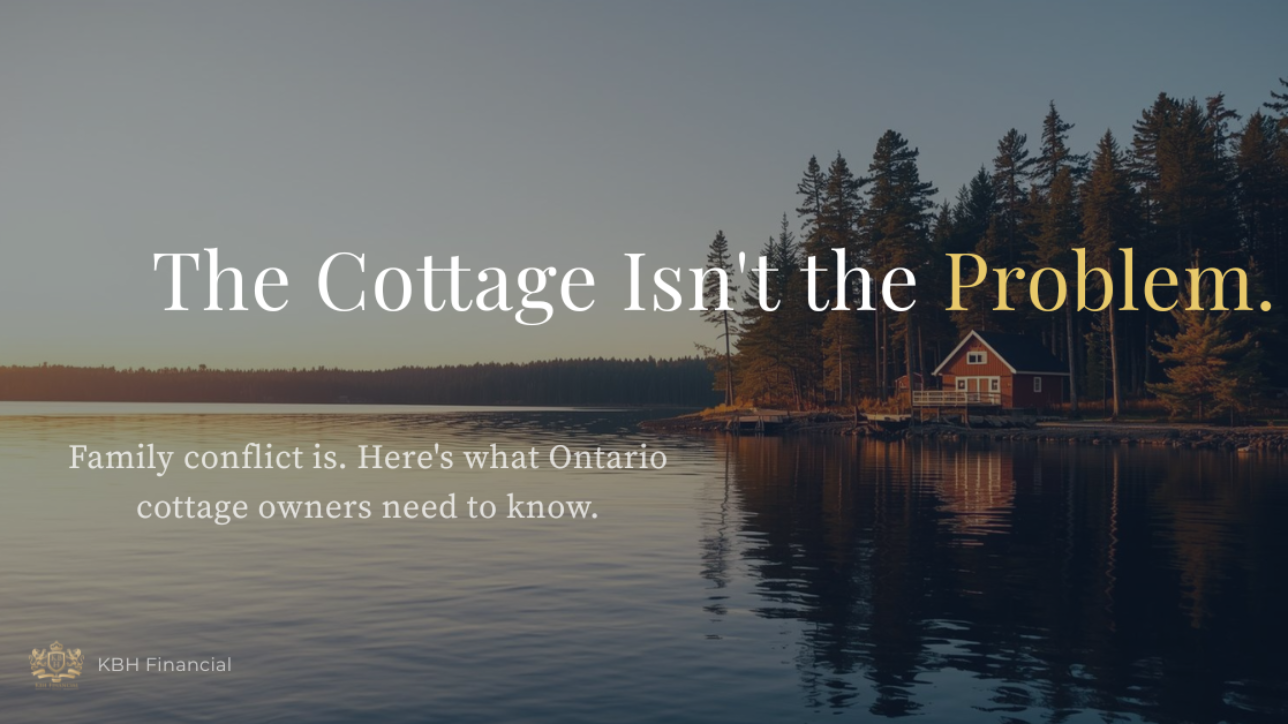
Cottages have a way of bringing families together. I know that our family cottage certainly has.
Cottages are where summer weekends stretch a little longer and sometimes start a little earlier. Those long weekends on the dock. Kids learning to paddle a canoe. Quiet mornings when the lake is perfectly still.
The cottage is where children slowly grow into adults without anyone quite noticing.
For many Canadian families, the cottage becomes part of the family identity. It’s the place everyone assumes will always be there.
And in many cases, it will be.
But over the years I’ve seen something surprising: When families struggle with a cottage’s future, it’s rarely about the property itself.
It’s not the dock that causes trouble (although that can, and certainly will happen).
It’s not the roof.
And most of the time, it’s not even the taxes.
More often, the challenge appears when the next generation begins to inherit not just the cottage… but the decisions that come with it.
Because in many situations, the cottage isn’t the problem.
Family conflict is.
The Kids Will Figure It Out.
One of the most common assumptions I hear from cottage owners is surprisingly simple.
“The kids will figure it out.”
I can understand that sentiment and, in some ways, it makes sense. After all, the cottage has always been a place where the family gathers. Everyone knows the routines. Everyone understands the memories attached to the property.
It’s easy to assume that the next generation will naturally want to keep things exactly the way they are.
But cottages can have a way of becoming more complicated as families grow.
And when those complexities aren’t talked about ahead of time, they can create pressure in places that families never expected.
That’s usually where the real challenge begins.
Where Conflict Actually Starts
When cottages create tension within a family, it rarely begins with a big argument.
More often, it starts with small differences that quietly grow over time.
One child may live nearby and use the cottage often. Another may live several hours away and only visit once or twice a year. Someone may love the idea of keeping it in the family, while someone else quietly wonders about the costs, but doesn’t want to sound selfish.
None of these perspectives are wrong. They’re simply different.
Then there are the practical realities.
Cottages need maintenance. Roofs eventually need replacing. Docks need repairs. Property taxes rise. And when the time comes to transfer the cottage to the next generation, there may also be capital gains taxes to consider.
None of these things are unusual. They’re simply part of owning a property that has been loved and used for many years.
But when expectations around these responsibilities aren’t clear, families can find themselves trying to solve difficult decisions in the middle of an emotional moment, like a catastrophic health event, or even the death of a parent.
And that’s rarely the best time to start figuring things out.
The Silent Problem
In many families, the cottage simply exists in a kind of quiet understanding.
Everyone assumes it will stay in the family.
Everyone assumes the children will work it out.
Everyone assumes there will be time to figure it out later.
But interestingly, very few families actually sit down and talk about it.
Parents often hesitate because they don’t want to create tension between their children. And the children themselves may avoid the topic out of respect. After all, the cottage still belongs to Mom and Dad.
So, the conversation gets postponed.
Sometimes for years.
Sometimes until a health event, a major life transition, or an estate settlement suddenly forces the discussion to happen much faster than anyone expected.
That’s when families often realize something important: Not everyone had the same understanding about the future of the cottage.
And once emotions are already running high, it becomes much harder to have the calm, practical conversations that could have made things easier for everyone.
A Little Planning Goes a Long Way
The good news is that most of these challenges are not inevitable. In many cases, they simply come from a lack of clarity.
When families take the time to talk openly about the future of the cottage, the conversation often becomes much easier than expected. Everyone has a chance to share what the property means to them and what they hope the future might look like.
Sometimes those conversations confirm that everyone wants to keep the cottage in the family. Other times they reveal that the next generation may have different priorities or practical concerns.
Both outcomes are perfectly normal.
The important thing is that these discussions happen early enough for thoughtful decisions to be made.
That might include thinking about things like ownership structure, how ongoing costs will be shared, or what options exist if someone eventually wants to step away from the arrangement.
With a little planning, many families find they can protect not only the cottage itself, but the relationships that make it meaningful in the first place.
A Small Step Toward Clarity
As a cottage owner, you may already have a sense of how these questions might apply to your own family. Some situations are very straightforward. Others have a few moving parts that aren’t always obvious at first.
That’s one of the reasons I created a short Cottage Legacy Readiness Quiz for Canadian cottage owners.
It takes about three minutes to complete and walks through a few of the key areas that tend to shape how smoothly a cottage can pass from one generation to the next.
The goal isn’t to give you all the answers. It’s simply to help you see where things may already be well aligned, and where a conversation might be helpful.
If you’re interested, you can try the quiz here: Cottage Legacy Readiness Quiz
A Final Thought
For many Canadian families, the cottage represents some of the best moments they’ve shared together. I know they do in my own family.
With a little thought and a few honest conversations along the way, it can continue to be that place for the next generation as well.
Because in the end, the goal isn’t just to pass on the cottage.
It’s to protect the family story that comes with it.
I wish you happiness and health, always.
With Gratitude,
Kevin-Barry Henry
THIS ARTICLE IS PROVIDED AS A GENERAL SOURCE OF INFORMATION ONLY AND SHOULD NOT BE CONSIDERED TO BE PERSONAL INVESTMENT OR LEGAL ADVICE. READERS SHOULD CONSULT WITH THEIR FINANCIAL OR LEGAL ADVISOR TO ENSURE IT IS SUITABLE FOR THEIR CIRCUMSTANCES.